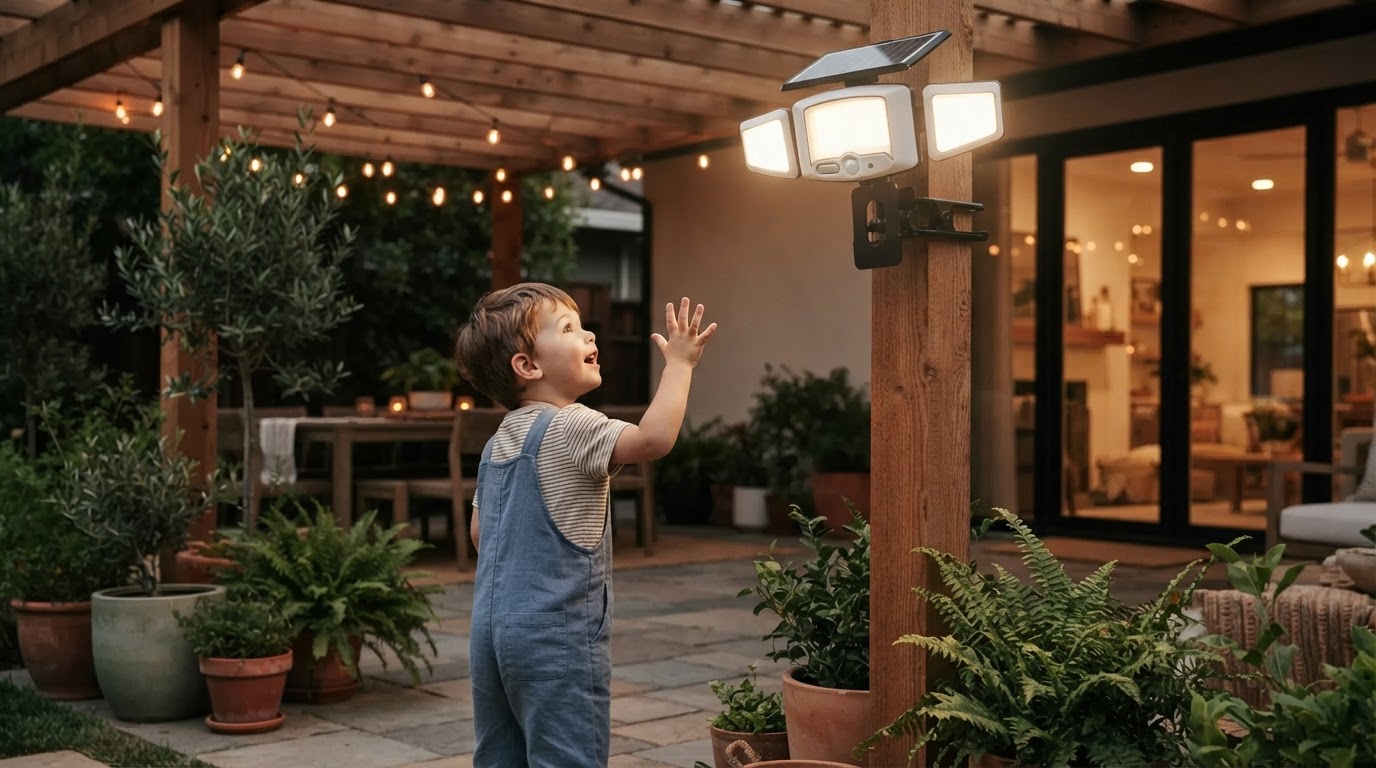
Solar Motion Sensor Flood Light Precision Install Strategy
 Maya ChenContributing Editor
September 9, 2026 — The market for interior task lighting is shifting toward hands-free operation, a trend led by Solar Motion Sensor Flood Light as users seek to eliminate physical contact with switches in high-utility areas. While most homeowners focus on brightness, the efficiency of a system depends entirely on the placement of the trigger mechanism. PureOptics LED notes that modern systems now allow for a 100% tool-free installation, removing the traditional barriers of wiring and drilling that previously defined the category. This shift toward modularity means that the specific geometry of the cabinet underside now dictates the success of the lighting array more than the raw wattage of the bulbs.
The Three-Point Placement Framework
The conventional wisdom says that you should center your light strip directly in the middle of the cabinet bottom, but this often results in a shadow cast by the user's body. Here's the part nobody talks about: the sensor needs to lead the light, not follow it. For effective under cabinet motion sensor lighting, the PIR (Passive Infrared) sensor must be positioned toward the front edge of the cabinet to catch thermal movement before the hand reaches the counter surface. According to LightKiwi, these sensors function by detecting body heat and movement within a specific detection range, instantly powering the connected LED. When applying this logic to a kitchen or workspace, the sensor should be offset by approximately two inches from the light source to prevent thermal interference. Run the math: a sensor with a 120-degree detection arc placed at a height of 18 inches covers a linear work area of roughly 60 inches. If you place the sensor at the back wall, you lose nearly 40% of that effective trigger zone to the backsplash. A professional installation requires identifying the 'dead zones' where cabinet dividers block the line of sight. By utilizing the same high-sensitivity PIR technology found in a standard Solar Motion Sensor Flood Light, interior units can provide instantaneous activation without the lag associated with cheaper, light-dependent resistors. The goal is a zero-latency response that activates the moment a limb enters the workspace.
Expert tip: When installing units near heat-producing appliances like toasters or ovens, shield the PIR sensor with a small lateral baffle. PIR technology reacts to rapid changes in heat, and an oven vent can trigger false positives that drain battery life or cycle the LEDs unnecessarily.
Effective task lighting requires a cohesive strategy across the home. This includes specialized motion activated pantry lighting for deep storage and rechargeable motion sensor night light units for hallways. In larger utility spaces, a [motion sensor light for closet](/blog/motion-sensor-light-for-closet) ensures visibility in tight corners, while broader under cabinet motion sensor lights manage the heavy lifting in the kitchen. I'll change my mind when manufacturers move away from PIR in favor of millimeter-wave radar, but for now, placement remains the only variable that matters.
Shop Solar Motion Sensor Flood Light.
Sources
- Motion Sensor Under Cabinet Lighting
- Motion Sensor for LED Under Cabinet Lights
- Motion Activated Under Cabinet Lighting Sensor (PIR)