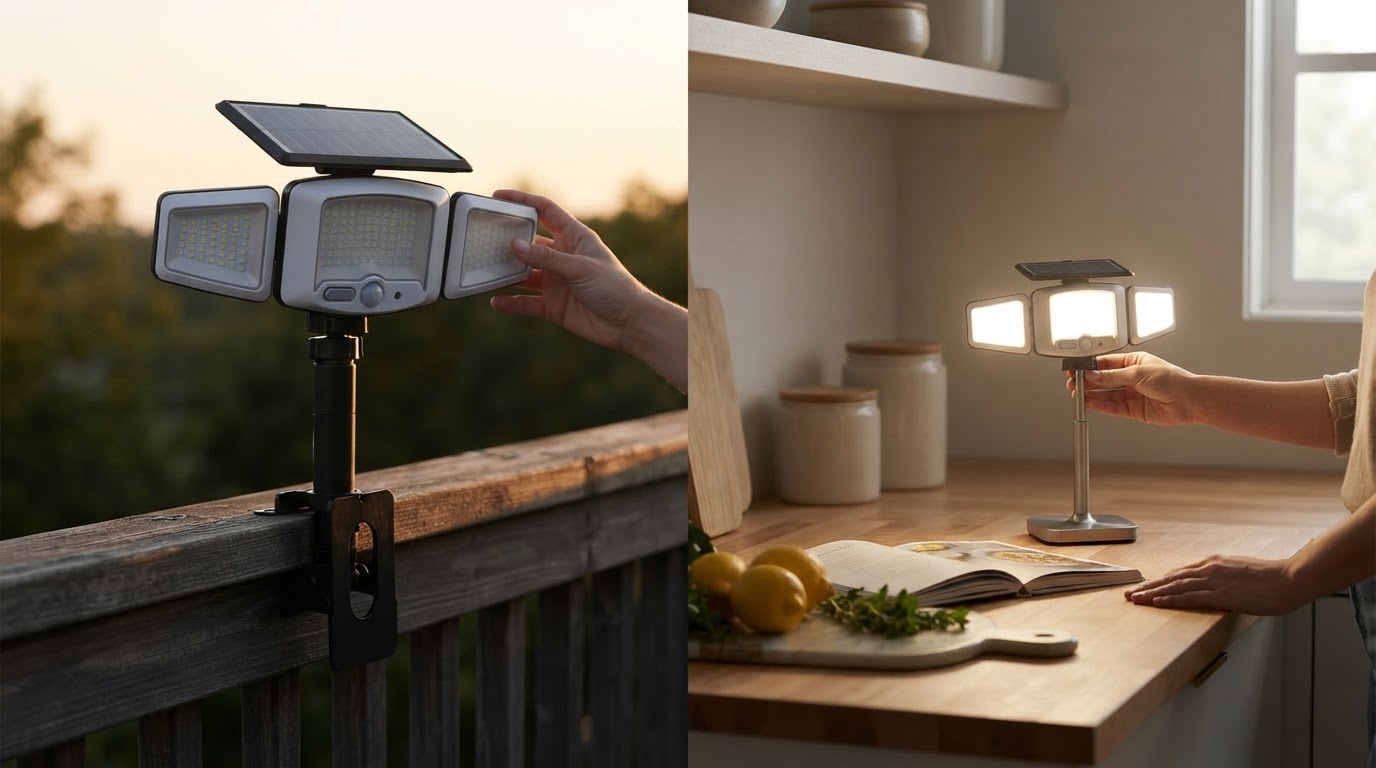
Solar Motion Sensor Flood Light Home Interior Application
 Daniel OkaforField Tester
September 10, 2026. This evaluation explores the practical transition of motion-sensing technology from high-output exterior units to the refined needs of indoor task lighting. It is written for homeowners seeking to eliminate dark spots in kitchens and workspaces without the complexity of hardwired electrical upgrades.
The Challenge of Shadowed Workspaces
I spent two weeks monitoring the light levels in my kitchen during meal preparation and early morning routines. The primary issue I encountered was not a lack of ambient light, but the presence of deep shadows cast by upper cabinets directly onto the primary work surfaces. In many residential kitchens, the central ceiling fixture creates a silhouette of the person standing at the counter, effectively blocking the light exactly where it is needed most. According to the Illumination Engineering Society, task lighting should provide focused illumination that reduces eye strain and improves safety during manual activities. Without dedicated under cabinet motion sensor lights, I found myself relying on harsh overhead lights that felt excessive for a simple glass of water at 3 AM.
I tested this for fourteen days, comparing how different zones in the house reacted to movement. In the kitchen, the delay in finding a wall switch often leads to minor accidents or fumbling in the dark. This same frustration carries over to storage areas, which is why I previously investigated motion activated pantry lighting to solve the visibility gap in deep shelving. What surprised me during this observation period was how much energy is wasted by leaving large room lights on just to perform a thirty-second task at the sink or stove. The need for a localized, responsive solution became clear by day three of the trial.
Adapting Solar Motion Sensor Flood Light Principles Indoors
Applying the rigorous standards of a Solar Motion Sensor Flood Light to an indoor environment requires a shift in scale but not in logic. While the exterior units are built to withstand heavy weather and illuminate large driveways, the core technology—passive infrared (PIR) sensing—remains the most effective way to manage indoor task lighting. I integrated several low-profile sensors under the cabinetry to see if they could replicate the reliability of my outdoor security setup. The immediate benefit was the hands-free operation; as soon as my hands moved toward the cutting board, the zone illuminated instantly.
What I'd do differently next time is focus more on the warmth of the LED diodes. While a Solar Motion Sensor Flood Light typically utilizes a cool 5000K to 6000K temperature for maximum visibility and security, indoor under-cabinet use benefits from a slightly warmer tone to avoid a clinical feel. However, the detection range must be just as precise. During my setup, I referenced the [under cabinet motion sensor lighting setup](/blog/under-cabinet-motion-sensor-lighting-setup) to ensure the sensors weren't being triggered by pets walking across the floor, but rather by intentional hand movements at counter height. Day three is where I noticed the battery efficiency; by using sensors that only trigger in low-light conditions, the units lasted significantly longer than 'always-on' alternatives. This efficiency mirrors the logic used when selecting a [rechargeable motion sensor night light](/blog/rechargeable-motion-sensor-night-light) for hallways, where constant power isn't feasible. The transition of this technology into the kitchen effectively turned a dark, static space into a reactive environment that anticipates user needs.
A Framework for Interior Sensor Integration
When you are deciding how to deploy these units, the focus should be on trigger zones and light overlap. Here's the moment it earned its place: I was carrying a heavy pot with both hands and didn't have to reach for a switch or even slow down; the path simply lit up. To achieve this, you need to map out where your body naturally blocks the light. This is similar to solving visibility issues in other cramped quarters, such as finding [solar motion sensor flood light closet solutions](/blog/solar-motion-sensor-flood-light-closet-solutions) for deep walk-ins. The goal is to create a seamless transition of light as you move through the home.
To ensure a successful installation, consider this decision framework:
- Identify the 'Shadow Zones' where overhead lighting fails to reach the counter surface.
- Select sensors with a 120-degree detection angle to ensure coverage across the entire workspace.
- Prioritize units with a 'Dusk to Dawn' feature so they don't waste battery during daylight hours.
- Opt for magnetic or adhesive mounts to allow for easy repositioning during the first week of testing.
- Ensure the light temperature complements your existing kitchen fixtures to prevent visual fatigue.
For those looking to secure their property perimeter with the same reliable motion-sensing technology discussed here, explore our full range of high-output exterior units.
Shop Solar Motion Sensor Flood Light here